Bi'an Du (杜毕安)

Ph.D. Candidate
Wangxuan Institute of Computer Technology, Peking University Beijing, People's Republic of China Email: scncdba@gmail.com Interests: Computer Vision, 3D/4D Generation/Reconstruction, World Modeling, Adversarial Robustness
Bi'an Du avatar

Biography

Bi'an Du is a fourth-year Ph.D. student at the Wangxuan Institute of Computer Technology, Peking University, advised by Prof. Wei Hu. He received his bachelor's degree from Peking University in 2022, where he studied in the Turing Class.

His research focuses on Computer Vision, with primary interests in 3D/4D generation and reconstruction, 3D understanding, and world modeling 🌍. More broadly, he is interested in building intelligent systems that can generate, perceive, understand, render, and iteratively refine realistic 3D worlds in a scalable and interactive manner, with the long-term goal of aligning such systems more closely with human cognition and physical understanding of the real world.

He has also worked on related topics including adversarial robustness, LVLM, video generation, and motion generation. He welcomes academic discussions, research collaborations, and related opportunities. 🤝

News

  • [2026-09]: Bi'an Du receives the National Scholarship
  • [2026-08]: 1 TMM paper accepted
  • [2026-03]: 1 ICME paper accepted
  • [2025-09]: 1 NeurIPS Workshop paper accepted
  • [2025-07]: 1 ACM MM paper accepted
  • [2024-09]: Bi'an Du receives the National Scholarship
  • [2024-04]: 1 CVPR paper accepted
  • [2023-03]: 1 TPAMI paper accepted
  • [2022-06]: Bi'an Du receives "Excellent Undergraduate" both in Peking University & Beijing
  • [2022-06]: Bi'an Du receives the Top-10 Excellent Undergraduate Thesis Award in EECS, Peking University
  • [2021-07]: 1 ACM MM paper accepted

Selected Papers

* Equal contribution.
  • PhysAg3D: Bridging 3D Generative and Agentic Models for High-Fidelity and Physically-Interactive Assets

    Bi'an Du*, Fanpeng Meng*, Jiemin Fang, Chen Yang, Pufan Li, Daizong Liu, Qi Tian, Wei Hu
    arXiv preprint arXiv:2610.39924,
  • TL;DR: PhysAg3D turns a single image into a detailed, physically interactive 3D asset by coupling a pretrained 3D generator with a vision-language agent. A hierarchical interaction representation connects semantic intent, mechanisms, and visible surfaces, while visual and execution feedback guides local refinement for rigid articulation and compliant deformation.
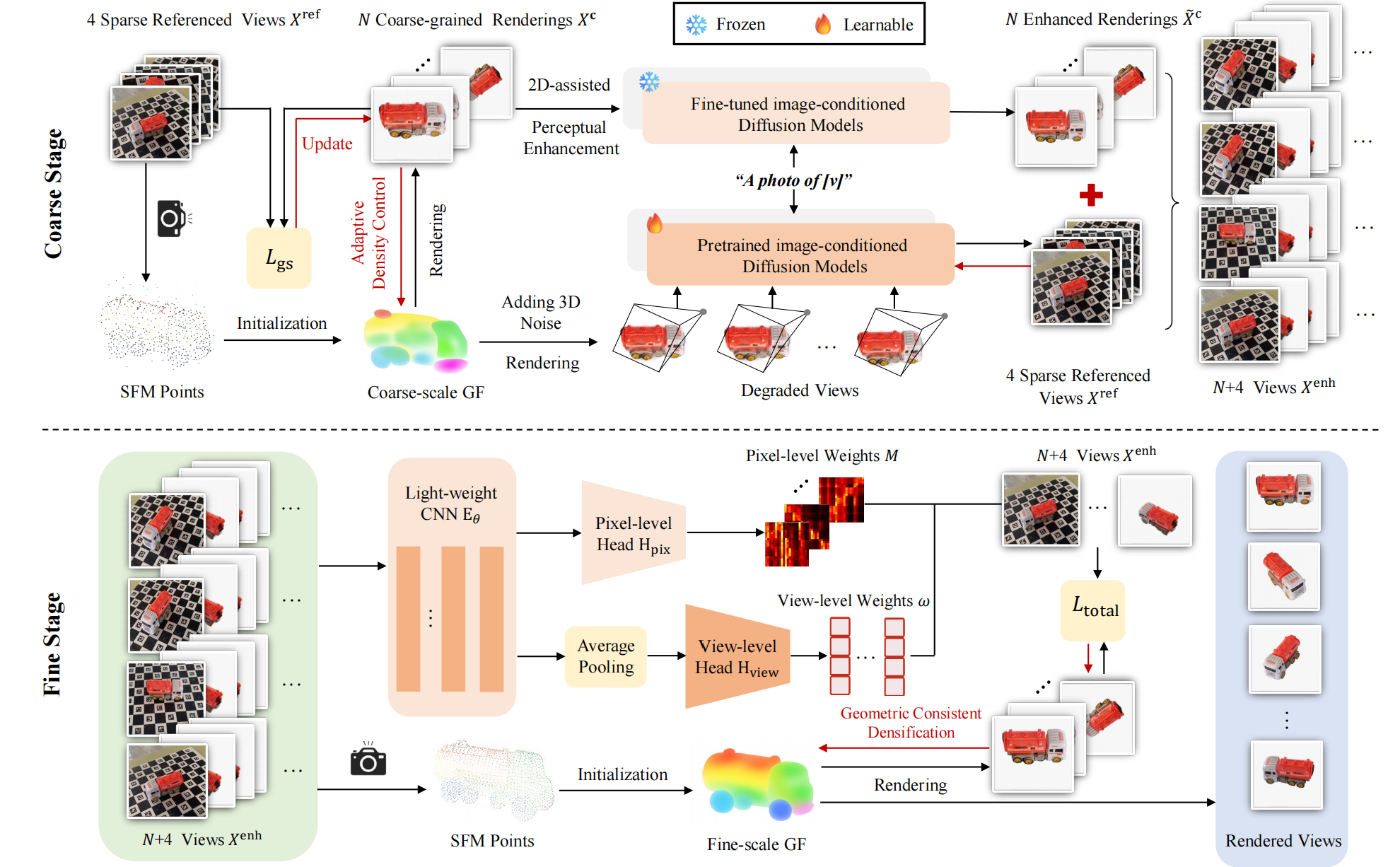
TMM 2026 HierGF overview: coarse-to-fine Gaussian fields with diffusion-assisted perceptual enhancement and confidence-guided geometric refinement
  • HierGF: Hierarchical Gaussian Fields via Geometry–perception Message Passing for Sparse-view 3D Reconstruction

    Bi'an Du, Zhimin Zhang, Daizong Liu, Baoquan Chen, Wei Hu
    IEEE Transactions on Multimedia (TMM), 2026
  • TL;DR: HierGF reconstructs 3D scenes from only a few images using coarse-to-fine Gaussian fields and geometry–perception message passing. Diffusion-enhanced pseudo-views provide additional visual supervision, while learned confidence weights and geometry-consistent densification improve multi-view consistency and recover fine details in under-sampled regions.
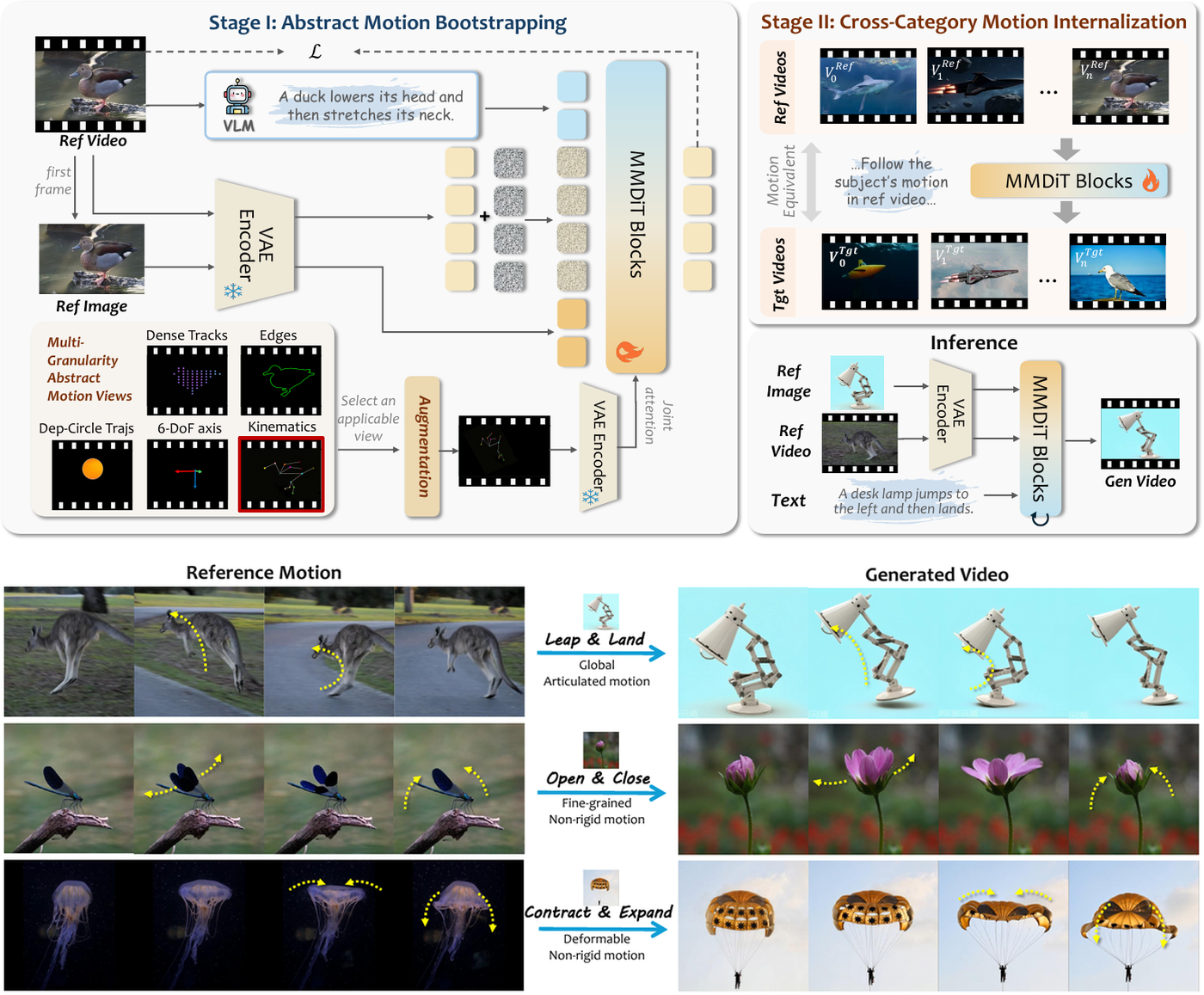
arXiv 2026 Motion Beyond Morphology method and results: abstract motion bootstrapping, cross-category motion internalization, and motion transfer examples across different morphologies
  • Motion Beyond Morphology: Bootstrapping Cross-Category Motion Transfer from Abstract Motion Representations

    Zhixue Fang*, Zhimin Zhang*, Bi'an Du, Zijie Meng, Yan Zhou, Wei Hu, Guoxin Zhang, Pengfei Wan, Kun Gai
    arXiv preprint arXiv:2608.01628,
  • TL;DR: This work transfers video motion across objects with different morphologies through a two-stage framework. Abstract motion representations bootstrap cross-category video pairs, which train a model to transfer motion directly from a reference video while preserving the target appearance. OpenVMT-Dataset and OpenVMT-Bench support training and evaluation.
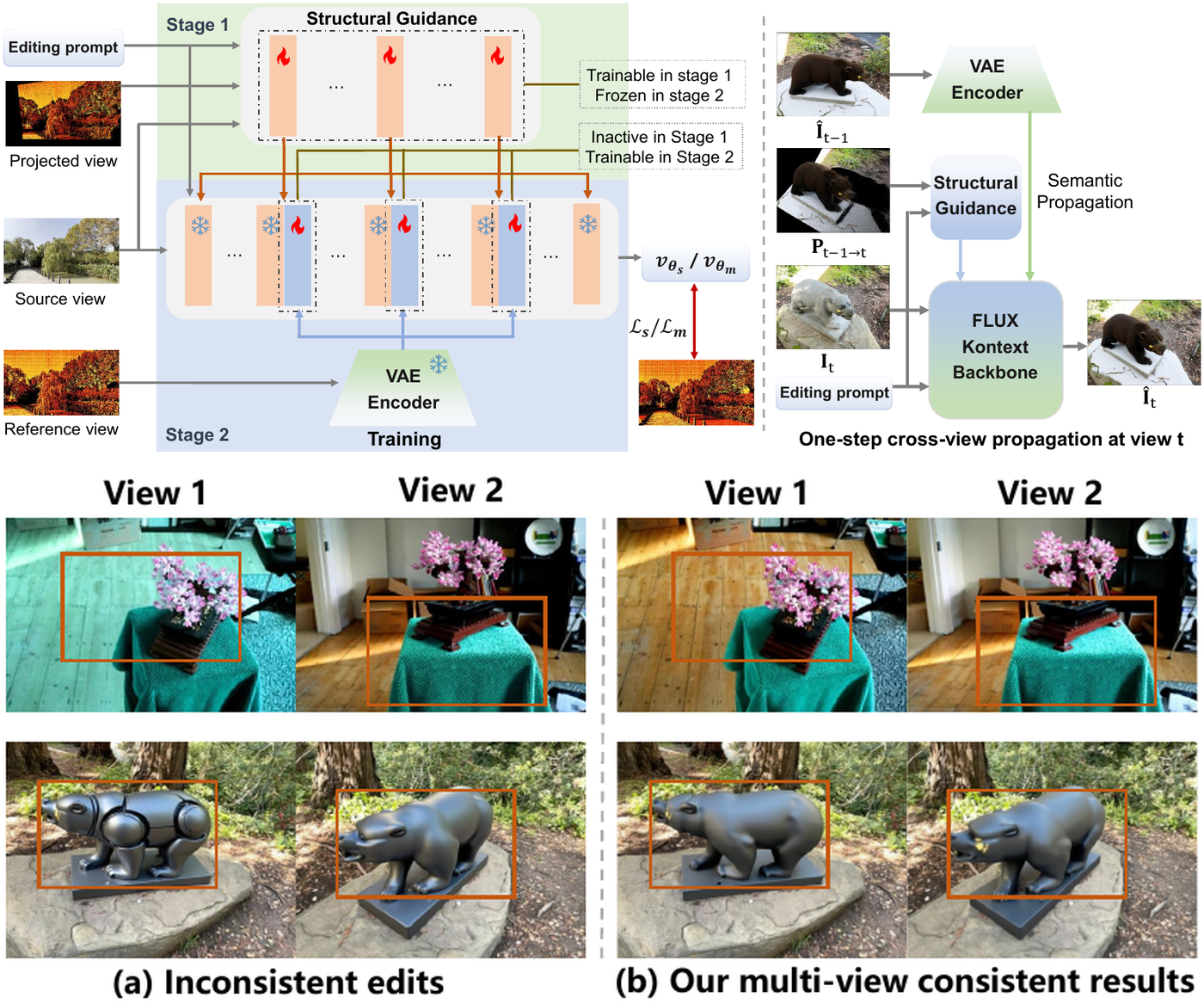
arXiv 2026 View-consistent 3D scene editing method and results: structural guidance and semantic propagation during training and inference, followed by consistent edits across viewpoints
  • View-Consistent 3D Scene Editing via Dual-Path Structural Correspondense and Semantic Continuity

    Pufan Li, Bi'an Du, Shenghe Zheng, Junyi Yao, Wei Hu
    arXiv preprint arXiv:2604.17801,
  • TL;DR: This work improves multi-view consistency in text-driven 3D scene editing by combining projection-guided structural guidance with patch-level semantic propagation. A paired multi-view editing dataset provides supervision for preserving structural correspondence and semantic continuity across edited viewpoints.
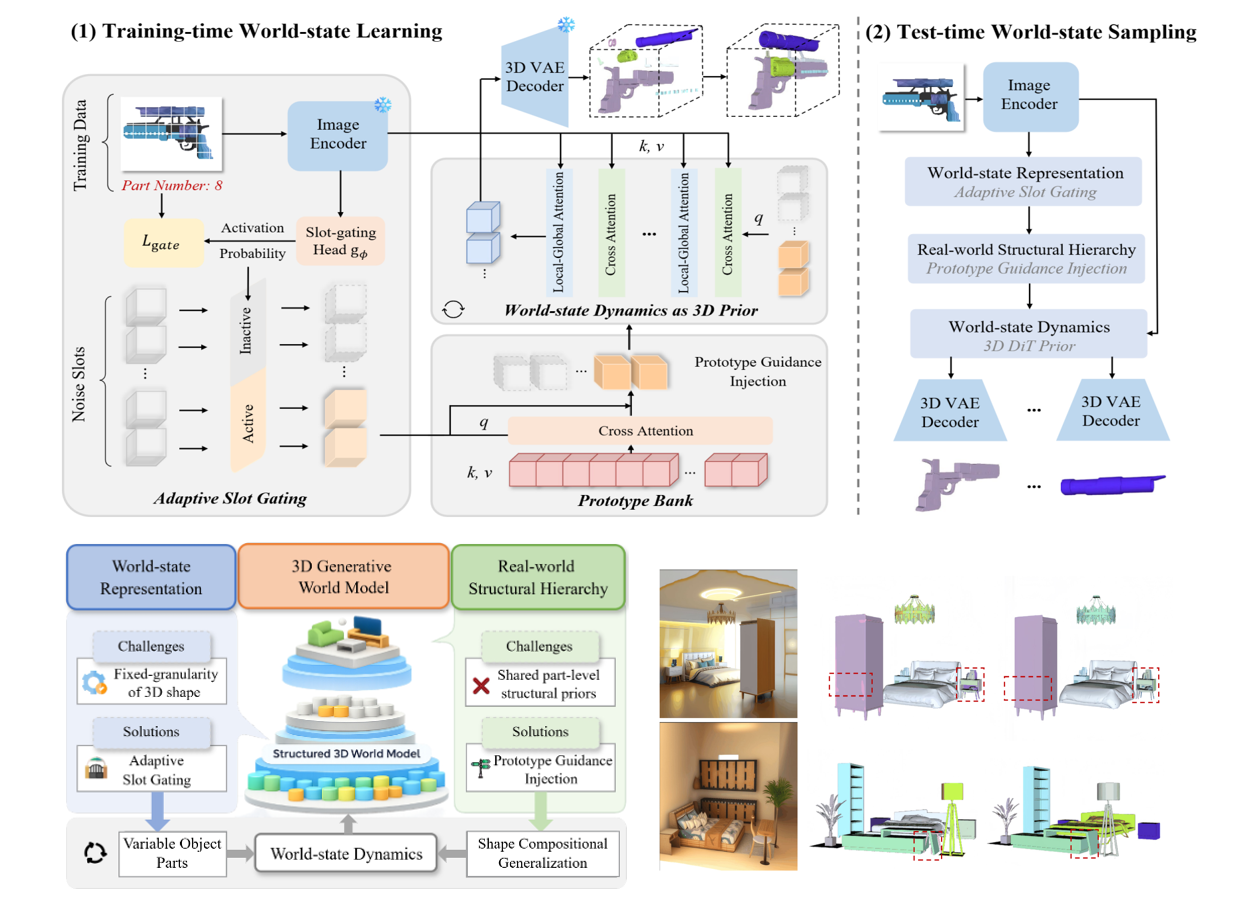
ICME 2026 Figure of From Part to Whole: 3D Generative World Model with an Adaptive Structural Hierarchy
  • From Part to Whole: 3D Generative World Model with an Adaptive Structural Hierarchy

    Bi'an Du, Daizong Liu, Pufan Li, Wei Hu
    IEEE International Conference on Multimedia and Expo (ICME), 2026
  • TL;DR: This work proposes a part-to-whole 3D generative world model that learns an adaptive structural hierarchy from a single image. Through slot-gating and prototype-based part sharing, it improves cross-category generalization, structural consistency, and part-count extrapolation under sparse supervision.
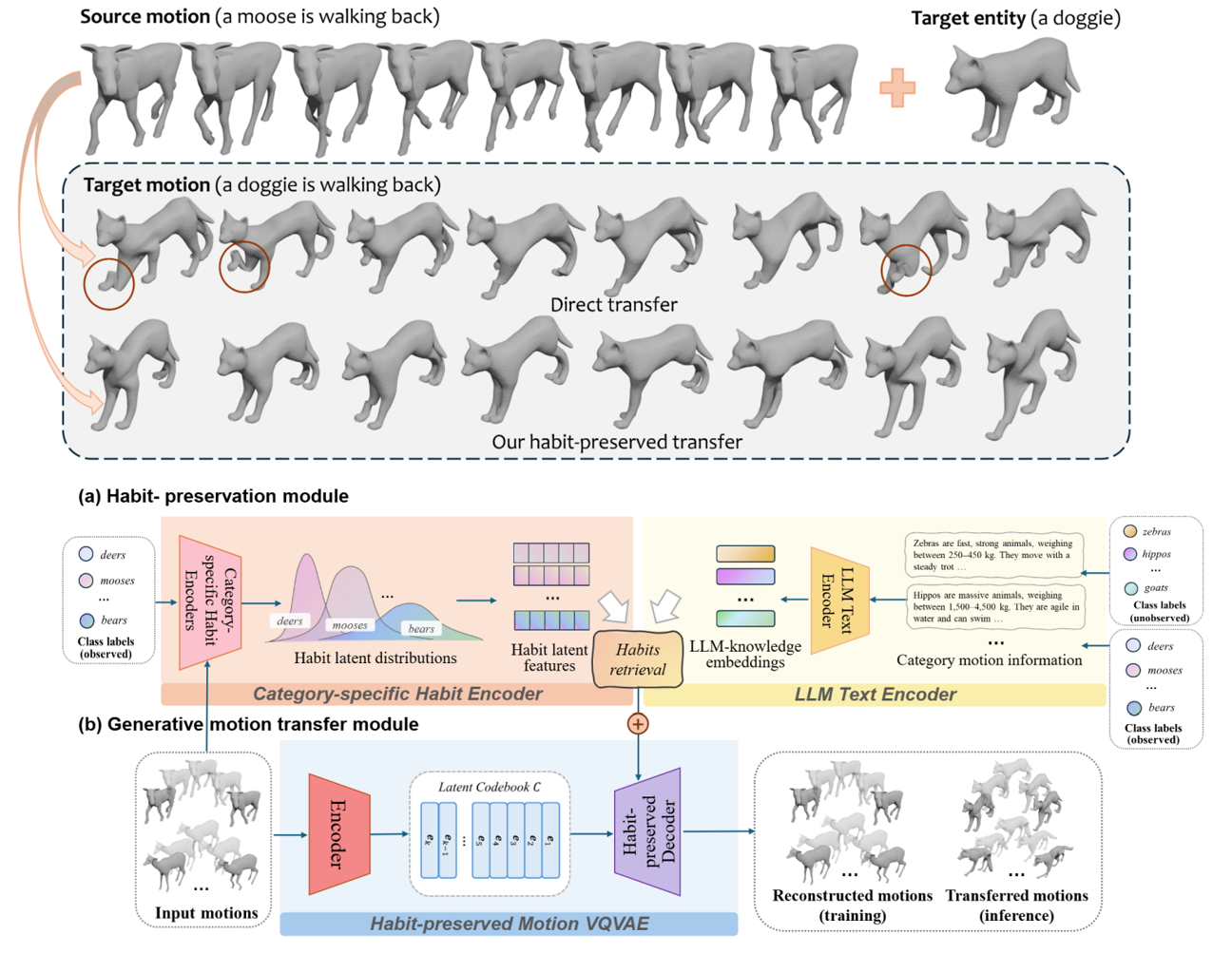
ACM MM 2025 Figure of Behave Your Motion: Habit-preserved Cross-category Animal Motion Transfer
  • Behave Your Motion: Habit-preserved Cross-category Animal Motion Transfer

    Zhimin Zhang*, Bi'an Du*, Caoyuan Ma, Zheng Wang, Wei Hu
    Proceedings of the 33rd ACM International Conference on Multimedia (ACM MM 2025)
  • TL;DR: This work explores cross-category animal motion transfer with an emphasis on preserving species-specific motion habits, enabling transferred motions that remain natural and behavior-consistent for the target category.
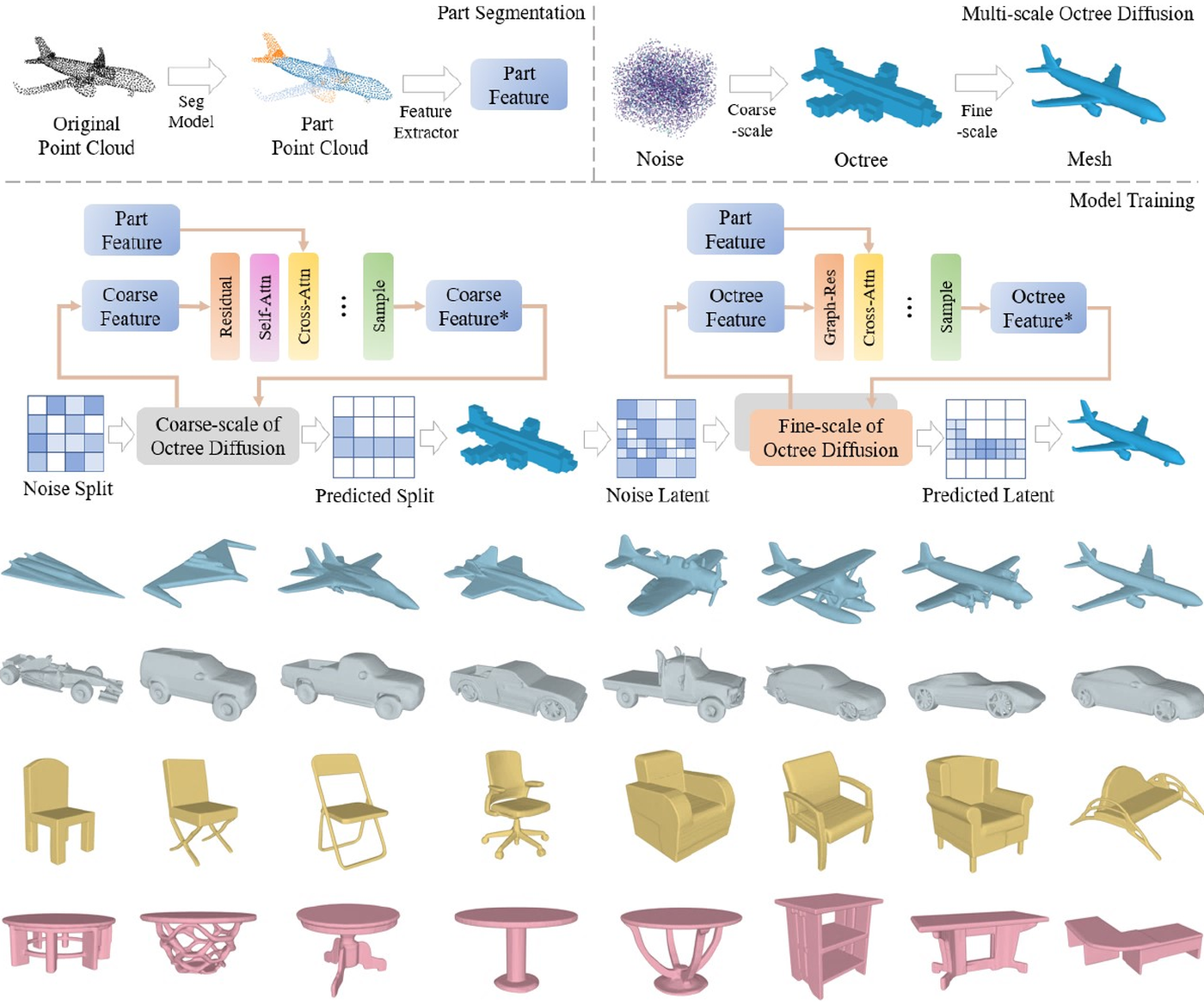
arXiv 2025 HierOctFusion method and results: semantic part segmentation guides coarse-to-fine octree diffusion through part-whole-hierarchy cross-attention, followed by generated airplanes, cars, chairs, and tables
  • HierOctFusion: Multi-scale Octree-based 3D Shape Generation via Part-Whole-Hierarchy Message Passing

    Xinjie Gao*, Bi'an Du*, Wei Hu
    arXiv preprint arXiv:2508.11106,
  • TL;DR: HierOctFusion generates 3D shapes with part-aware, multi-scale octree diffusion. Part-whole-hierarchy cross-attention injects semantic part features into coarse-to-fine generation, improving structural detail and efficiency. The ShapeNet-Seg dataset provides part annotations for training and evaluation.
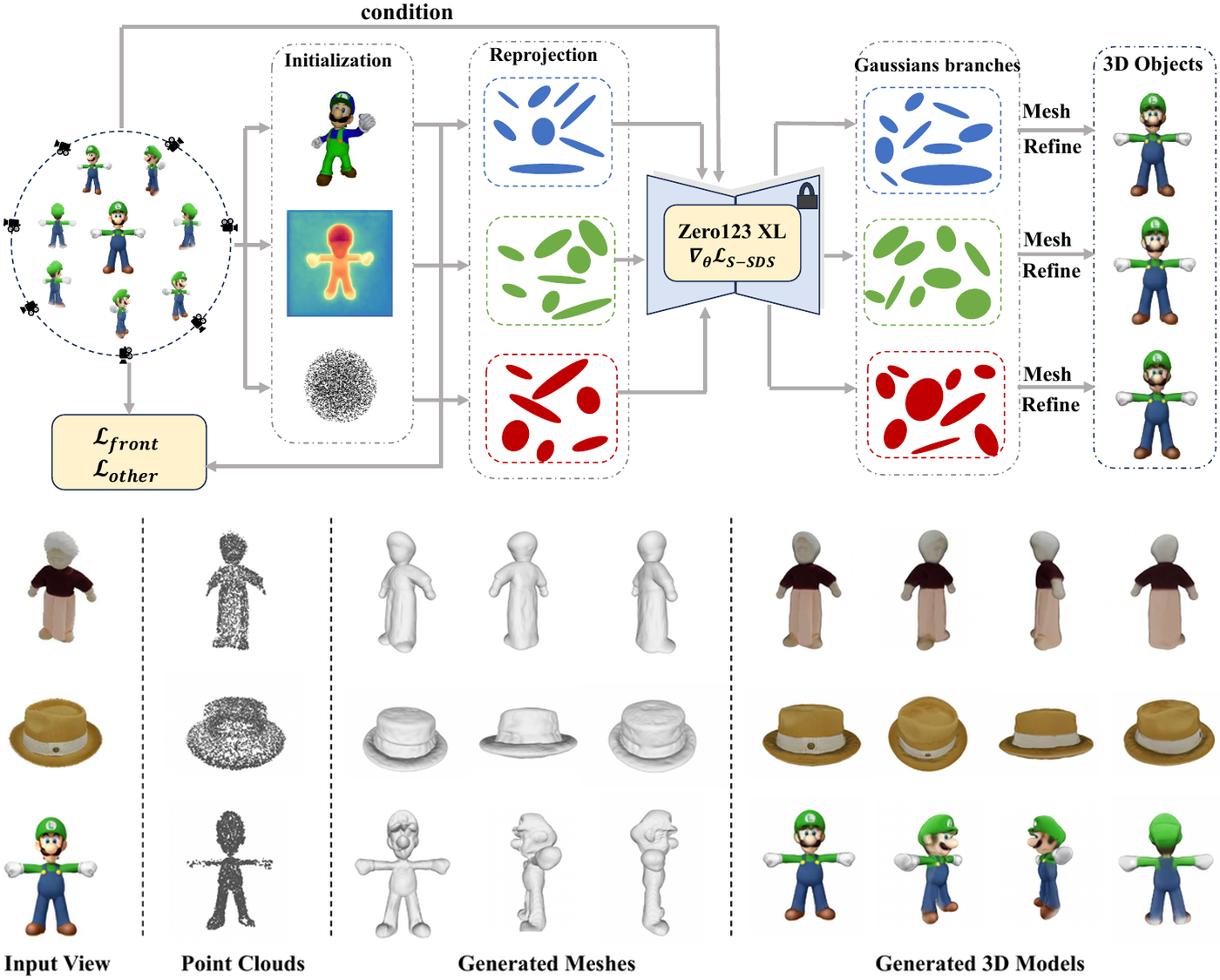
arXiv 2025 Geometry and perception guided Gaussian method and results: prior-guided Gaussian branches with reprojection and stable score distillation, followed by generated point clouds, meshes, and multiview renderings
  • Geometry and Perception Guided Gaussians for Multiview-consistent 3D Generation from a Single Image

    Pufan Li*, Bi'an Du*, Wei Hu
    arXiv preprint arXiv:2506.21152,
  • TL;DR: This work generates detailed 3D objects from a single image by integrating geometry and perception priors into multiple Gaussian branches without additional model training. Stable score distillation and a depth-consistency reprojection strategy improve geometric detail and consistency across viewpoints.
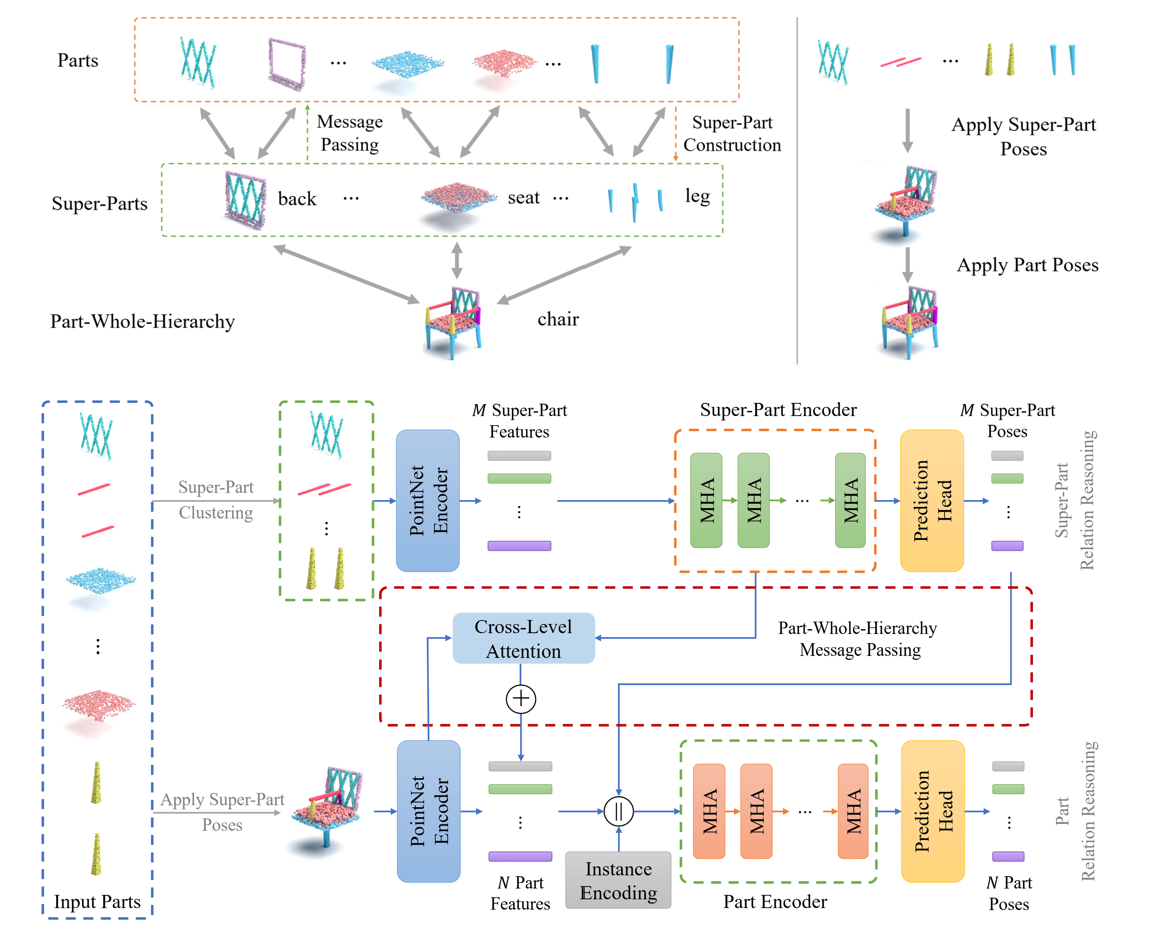
CVPR 2024 Figure of Generative 3D Part Assembly via Part-Whole-Hierarchy Message Passing
  • Generative 3D Part Assembly via Part-Whole-Hierarchy Message Passing

    Bi'an Du, Xiang Gao, Wei Hu, Renjie Liao
    IEEE/CVF Conference on Computer Vision and Pattern Recognition (CVPR), 2024
  • TL;DR: This work introduces a part-whole-hierarchy message passing framework for generative 3D part assembly. By first estimating latent super-part poses and then refining part-level poses with hierarchical interactions, it improves assembly accuracy, connectivity, and interpretability on PartNet.
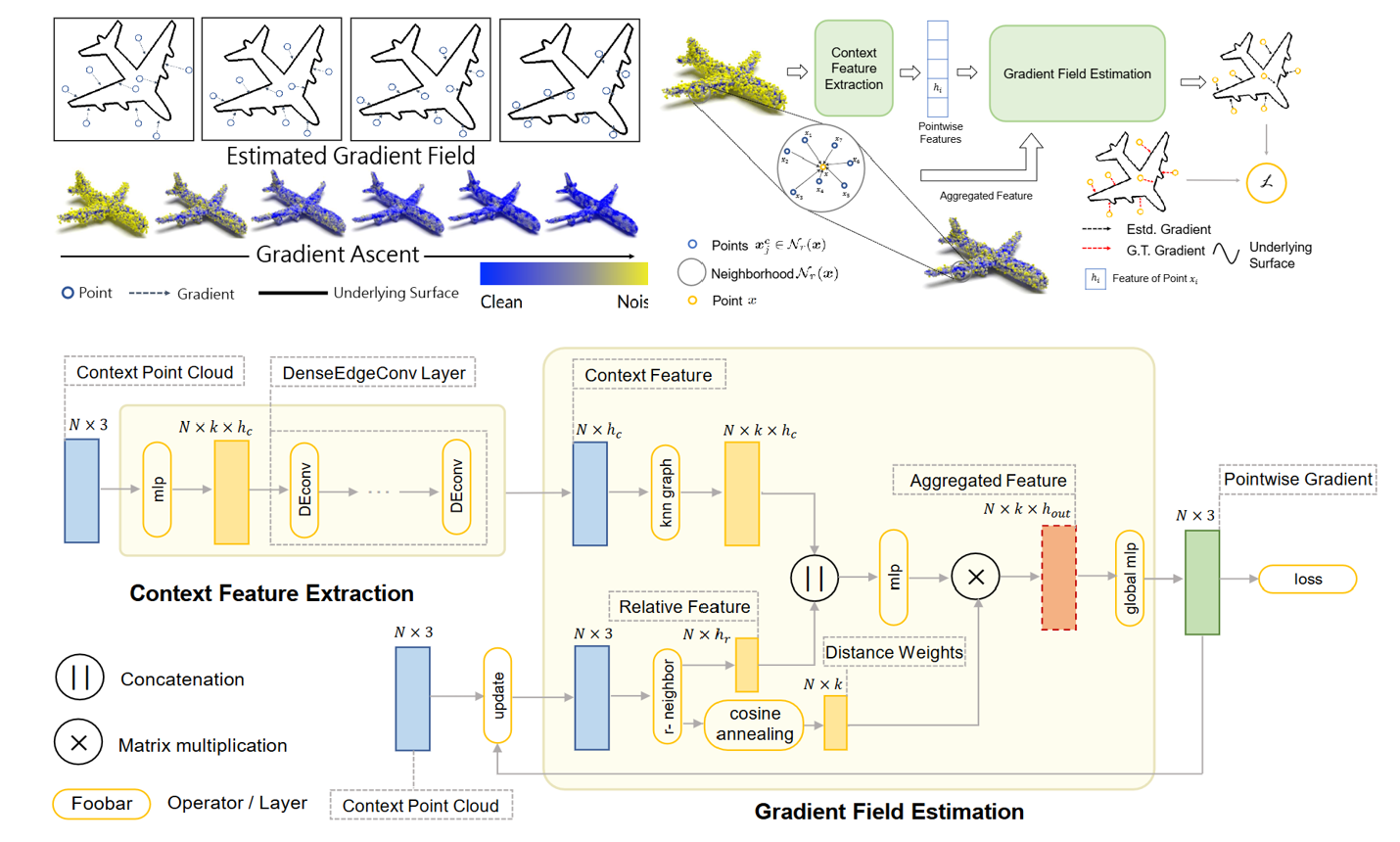
TPAMI 2023 Figure of Deep Point Set Resampling via Gradient Fields
  • Deep Point Set Resampling via Gradient Fields

    Haolan Chen*, Bi'an Du*, Shitong Luo, Wei Hu
    IEEE Transactions on Pattern Analysis and Machine Intelligence (TPAMI), 2023
  • TL;DR: This work formulates point cloud restoration as gradient-field learning and performs iterative gradient ascent to move degraded samples toward clean underlying surfaces. A continuous gradient prior enables strong denoising and upsampling performance across noisy and sparse point cloud settings.
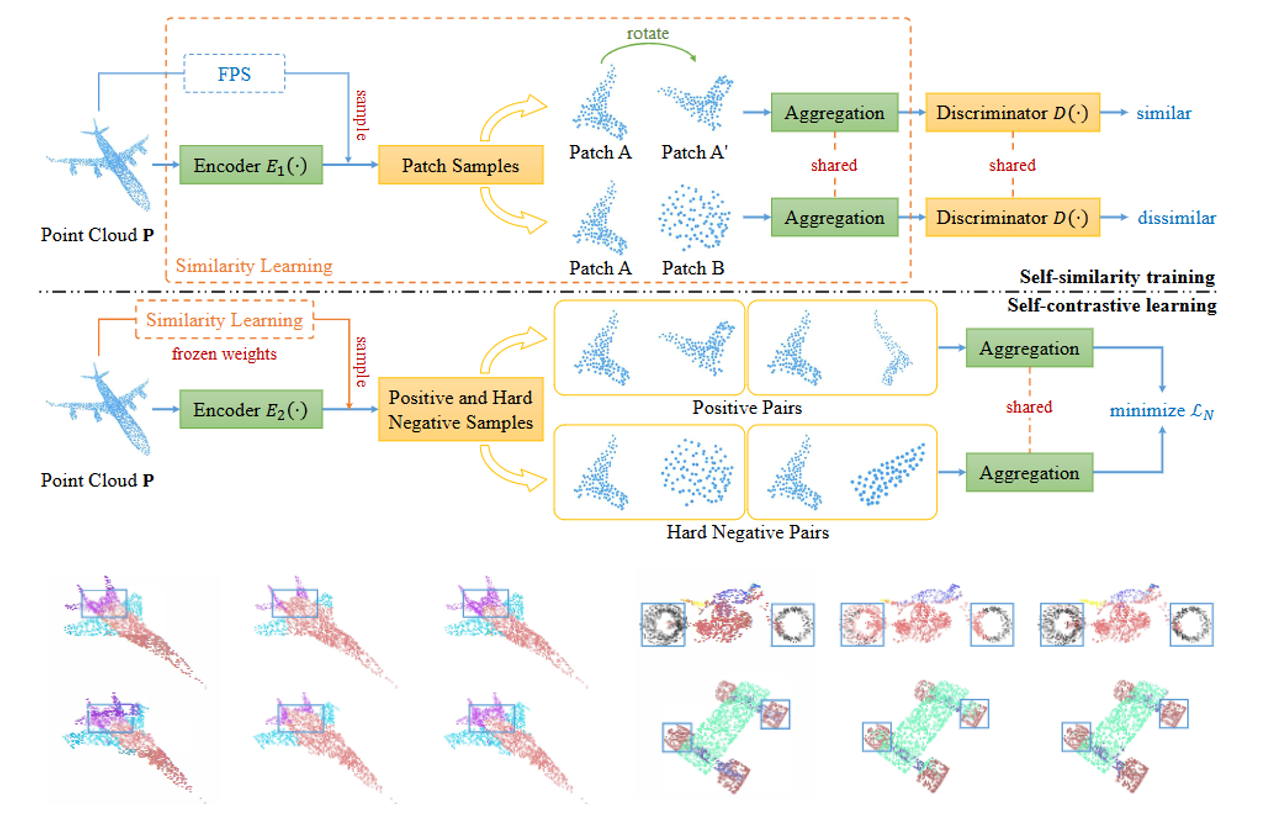
ACM MM 2021 Figure 2 of SCL paper
  • Self-Contrastive Learning with Hard Negative Sampling for Self-supervised Point Cloud Learning

    Bi'an Du, Xiang Gao, Wei Hu, Xin Li
    Proceedings of the 29th ACM International Conference on Multimedia (ACM MM 2021)
  • TL;DR: This work proposes a self-contrastive learning framework with hard negative sampling for self-supervised point cloud representation learning. By mining informative negative pairs and jointly optimizing self-similarity and contrastive objectives, SCL learns stronger 3D features and improves transfer performance on downstream classification and segmentation tasks.

🎓 Education

  • Ph.D. Student, Wangxuan Institute of Computer Technology, Peking University 2022 - Present
  • Bachelor's Degree, Turing Class, Peking University 2018 - 2022

🏆 Honors & Awards

  • National Scholarship, Ministry of Education (the highest honor scholarship in China) 2026
  • Huawei Scholarship, Peking University; Outstanding Research Award, Peking University 2025
  • National Scholarship, Ministry of Education (the highest honor scholarship in China); Merit Student, Peking University 2024
  • Merit Student, Beijing Municipality; Liao Kaiyuan Scholarship, Peking University; Merit Student, Peking University; First Prize of Wang Xuan Scholarship, WICT of Peking University 2023
  • Outstanding Graduate, Beijing Municipality; Outstanding Graduate, Peking University; Top 10 Outstanding Undergraduate Theses, EECS, Peking University (10 recipients per year) 2022
  • CCF Outstanding Undergraduate Student Award (only around 100 recipients nationwide each year); POSCO Scholarship, Peking University; Academic Innovation Award, Peking University; Merit Student, Peking University 2021

📝 Services

  • Members of the following Committees:
    • International Conference on Multimedia Retrieval 2026 Program Committee (ICMR-PC) Member
  • Reviewer for the following Journals:
    • IEEE Transactions on Pattern Analysis and Machine Intelligence (TPAMI)
    • IEEE Transactions on Image Processing (TIP)
    • IEEE Transactions on Signal Processing (TSP)
    • IEEE Transactions on Multimedia (TMM)
    • Transactions on Machine Learning Research (TMLR)
    • Neural Networks (Neural Netw.)
    • IEEE Transactions on Visualization and Computer Graphics (TVCG)
  • Reviewer for the following Conferences:
    • IEEE Conference on Computer Vision and Pattern Recognition (CVPR)
    • IEEE/CVF International Conference on Computer Vision (ICCV)
    • European Conference on Computer Vision (ECCV)
    • International Conference on Learning Representations (ICLR)
    • Conference on Neural Information Processing Systems (NeurIPS)
    • ACM International Conference on Multimedia (ACM MM)
    • AAAI Conference on Artificial Intelligence (AAAI)
    • IEEE International Conference on Multimedia and Expo (ICME)

Contact